
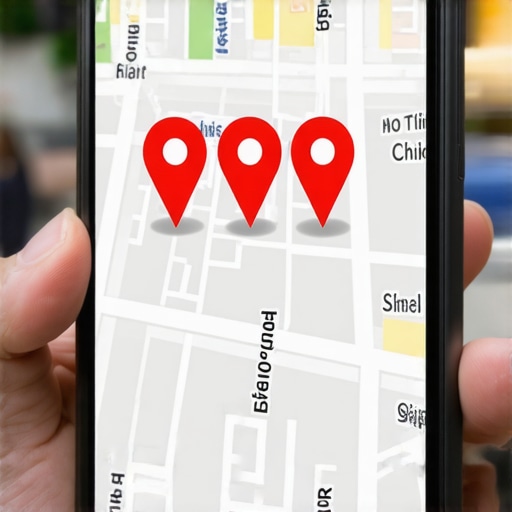
My morning always starts with the smell of stale coffee and the hum of a logistics engine. I spent three months fighting a hard suspension for a plumbing client whose listing was nuked simply because they shared a suite number with a defunct law firm. Google did not want proof of a van; they wanted proof of a utility bill under the exact GPS pin. This is the reality of the local search layer. It is not about your blog posts or your keyword density. It is about spatial integrity. When you are managing a fleet or a storefront, your Google Business Profile is a proximity beacon. If the signal is weak, the traffic stops. We are going to look at the microscopic math of proximity and why you can dominate the map pack without ever touching your website organic copy.
The math of the centroid determines your visibility
The primary ranking factor for the Map 3-Pack is the physical distance between the searcher and your business centroid. Google calculates a proximity radius based on category competition and user density. You can influence this signal by tightening your location authority and ensuring your GPS coordinates are verified through customer behavioral signals rather than just a static address entry on a map.
I view every business listing as a dispatch point in a massive grid. The algorithm is not reading your content like a librarian; it is measuring you like a surveyor. Most people think they need better keywords. They are wrong. They need better signal salience. I have seen businesses with terrible websites rank in the top spot because their behavioral zoom was perfect. They had consistent check-in data and photo metadata that proved they were exactly where they said they were. This is why mastering local search signals is the only way to move the needle when the organic content is already locked in.
“Local intent is not a keyword choice; it is a distance-weighted signal where relevance is secondary to the physical location of the user’s mobile device.” – Map Search Fundamental
The logic of a check-in signal is mathematical. When a user arrives at your shop with their phone in their pocket, Google tracks that movement. That is a vote of confidence. If you want to rank without changing your site, you need to increase the density of those real-world signals. This is far more effective than any meta tag. We focus on the physics of the three mile radius. If you can prove you are the most active node in that circle, you win. This involves looking at how local ranking factors influence your map visibility from a purely technical perspective.
Why a google business profile ranking software is your new dispatch board
A google business profile ranking software allows you to track the exact grid points where your business disappears from view. These tools provide a heat map of your visibility across specific GPS coordinates. This data tells you exactly where your proximity beacon is failing and where a competitor is siphoning off your local leads.
When I audit a new client, I do not look at their H1 tags first. I look at their coordinate salience. Many agencies use a gmb ranking toolkit to see if a business is being filtered out due to proximity to a competitor. If you are in a high-rise with five other plumbers, you are fighting a technical battle, not a content battle. You need to know what is a gmb ranking toolkit and how it differs from traditional SEO trackers. It is about tracking the map pack, not the blue links.
The flow of data is what matters. If your software shows a sudden drop in a specific neighborhood, it usually means a new competitor has established a stronger behavioral footprint there. You do not fix that with a blog post. You fix it by generating localized reviews and high-resolution photos from that specific area. This is the toolkit that saved our service area business when the map rankings started to wobble. We used the data to redirect our local presence.
Solving the puzzle of duplicate locations and hidden filters
The Google filter for duplicated locations is a silent killer that removes your business from the map pack without warning. This happens when two businesses in the same category share a building, a phone number, or a similar name. The algorithm chooses one to show and hides the other to prevent map spam.
I have spent countless hours in the trenches of the reinstatement war. One client lost half their revenue because they were stuck in a filter for duplicated locations. We had to prove to the spam team that two separate entities were operating from the same floor. This is where seo services to fix gmb profile stuck in filter become vital. You need a forensic trace of your business history to break out of that loop. It is about data hygiene, not creative writing.
If you have switched your business model or rebranded, the ghost of your old profile might still be haunting the database. You might need local seo services to repair ranking after switching business model. Google hates ambiguity. If the machine sees a conflict in your Point of Sale data or your utility records, it will simply ghost your listing. This is why cleaning up ghost locations is a mandatory part of any map pack strategy. You have to remove the noise so the signal can get through.
Local Authority Reading List
- Top Local Search Signals for 2025
- Decoding Google Ranking Signals Guide
- The Ultimate Blueprint for Local Success
- The Map Pack Secret for Growth
The behavioral signals that act as proximity beacons
Customer behavioral signals like review sentiment and photo engagement are now the strongest influencers of map pack rankings. When a real person uploads a photo from your storefront, that image contains EXIF data that confirms their physical location. This is a massive trust signal for the Google algorithm.
I tell my clients that a single photo from a customer is worth ten keyword-optimized pages. Why? Because the machine cannot be fooled by an image taken at the actual coordinates. If you are struggling, you might need reputation management and review repair services to fix a damaged behavioral footprint. A negative review attack can kill your proximity radius overnight. We use gmb spam fighting and review cleanup services to protect the integrity of the profile. It is about keeping the dispatch lines clear.
“Proximity is a mathematical certainty in the eyes of the AI; however, behavioral trust is the variable that allows a smaller business to outrank a larger one from further away.” – Location Intelligence Whitepaper
The forensic trace of a service area polygon is another factor. If you tell Google you serve a 50 mile area but all your reviews come from a 5 mile circle, the machine knows you are exaggerating. You have to align your stated service area with your actual customer data. This is how we use tools to fix low gmb rankings. We stop guessing and start following the data flow. If the numbers do not match, the rank will not follow.
Fixing the mess of citation footprints and old address data
Mismatched NAP data across the web creates friction in the map algorithm and suppresses your ranking potential. NAP stands for Name, Address, and Phone Number. If your business has moved or changed its name, the old footprints act as anchors that pull your current profile down.
I hate wasted travel time and I hate wasted data. If Google finds your old address on a dead directory from 2014, it creates a trust conflict. You need to be cleaning up the messy citations that are costing you clicks. This is not about building new links; it is about destroying the old, incorrect ones. Many businesses are losing clients to mismatched address data without even knowing it. The machine sees the conflict and drops you from the 3-pack to be safe.
Your technical infrastructure must also be clean. If your site has soft 404 and duplicate content issues, it signals to Google that your business is not being managed well. We use services to fix soft 404 and duplicate content issues because they directly impact your local trust score. A broken link on your site is a broken road in the digital map. You cannot expect a smooth flow of traffic if the infrastructure is crumbling. This is why we focus on cleaning up old search footprints before we even think about new content.
The simple checklist for fixing 404 errors on your business site
A healthy site architecture is the foundation for a stable map pack ranking. While map rankings are largely driven by off-page signals, technical errors on your domain can trigger a ranking drop if the algorithm decides your site is unreliable for users.
When a user clicks your website button from the Map Pack and hits a 404 error, Google tracks that bounce. It is a signal that your business might be closed or unmanaged. You need to be fixing the 404 errors that are frustrating your clients. This is a logistics problem. If the route is blocked, the customer goes to the competition. We use a simple checklist for fixing 404 errors to ensure the path from the map to the conversion is clear.
If you have recently suffered a loss in visibility, it could be due to a recent core update that shifted how local intent is weighted. You might need seo services to recover traffic after google update. The algorithm is constantly recalibrating the weight of proximity versus relevance. You have to stay ahead of the curve. Use the blueprint for recovering a lost local map ranking fast to get your beacon back on the grid. The map is not a static image; it is a living, breathing database of movements and trust. Keep your data clean, keep your coordinates verified, and you will stay in the 3-pack without ever having to write a single new word of organic copy.